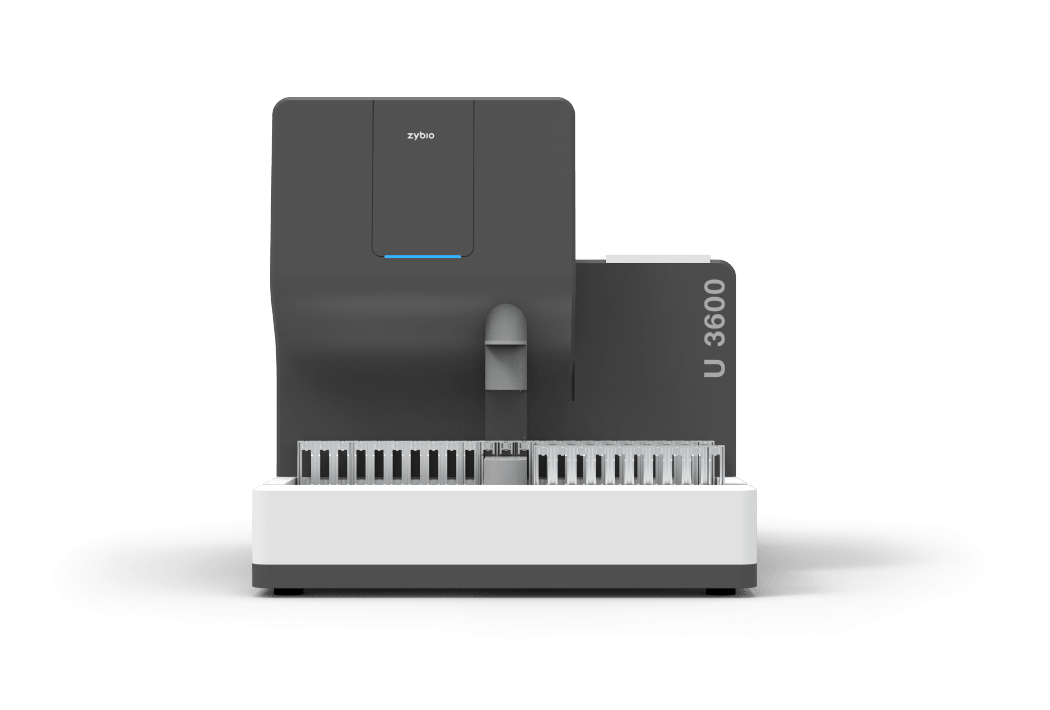
Zybio U3600 Urine Analyzer System
Zybio U-3600 Urinalysis Hybrid System (also referred to as U 3600) is an integrated, automated urine analyzer that combines physical, chemical (dry chemistry), and morphological (formed particle/sediment) analysis in a single compact machine.
Core Technologies
Common parameters include: Urobilinogen (URO), Bilirubin (BIL), Ketone (KET), Leukocyte (LEU), Nitrite (NIT), Protein (PRO), Blood (BLD), Glucose (GLU), pH, Vitamin C (VC), Specific Gravity (SG), Microalbumin (MALB), Creatinine (CRE), Calcium (Ca), plus ratios ACR (Albumin-Creatinine) and PCR (Protein-Creatinine).Morphology / Formed Particles (Total 46):
RBC (and variants: NRBC, DRBC, LRBC, MRBC, RBCC, etc.), WBC (and variants: WBCC, PMN, etc.), Epithelial cells (SQEP, NSE, RTEC, etc.), Casts (HYAL, UNCC, BROAD, WAXY, etc.), Crystals (COM, COD, URIC, AUCR, TYRO, CAPH, MAPH, AMOR, etc.), Bacteria (BACI, SUCO), Yeast (BYST, HYST), Sperm (SPRM), Mucus (MUCS), Fat (FAT), and others like PHCY, UNCX, UNCL, etc.Key Advantages & Usability
- Laminar Flow Digital Imaging for morphology: Samples are wrapped in sheath fluid and flow in a single-cell-layer thin structure. This prevents overlap/aggregation, eliminates centrifugation and staining, and enables clear imaging.
- High-speed Photography: Captures images without trailing or blurring.
- Image Resolution: 1440 × 1080 pixels.
- Medical Image Recognition: Extracts features using a powerful clinical database for accurate classification.
- Full Spectrum Photoelectric Colorimetry for dry chemistry.
- Low Carry-Over: ≤ 0.05% (even at high concentrations up to 100,000 particles/μL). Uses disposable cuvettes.
- Throughput:
- Dry Chemistry mode: 240 tests/hour
- Morphology / Combined (Hybrid) mode: 120 tests/hour
- Sample Capacity: 60 samples (10 samples × 6 racks). Supports auto-loader and STAT (emergency) priority mode.
- Test Strip Capacity: 300 strips.
- Dimensions: 687 mm (W) × 512 mm (D) × 530 mm (H).
- Weight: 55 kg.
- Power Supply: 90–264 V, 47–63 Hz.
- Operating Environment: 10–30°C, <80% humidity, 70–106 kPa atmospheric pressure.
Common parameters include: Urobilinogen (URO), Bilirubin (BIL), Ketone (KET), Leukocyte (LEU), Nitrite (NIT), Protein (PRO), Blood (BLD), Glucose (GLU), pH, Vitamin C (VC), Specific Gravity (SG), Microalbumin (MALB), Creatinine (CRE), Calcium (Ca), plus ratios ACR (Albumin-Creatinine) and PCR (Protein-Creatinine).Morphology / Formed Particles (Total 46):
- Auto-classification: 25 types.
- Manual/review classification: 21 additional types.
RBC (and variants: NRBC, DRBC, LRBC, MRBC, RBCC, etc.), WBC (and variants: WBCC, PMN, etc.), Epithelial cells (SQEP, NSE, RTEC, etc.), Casts (HYAL, UNCC, BROAD, WAXY, etc.), Crystals (COM, COD, URIC, AUCR, TYRO, CAPH, MAPH, AMOR, etc.), Bacteria (BACI, SUCO), Yeast (BYST, HYST), Sperm (SPRM), Mucus (MUCS), Fat (FAT), and others like PHCY, UNCX, UNCL, etc.Key Advantages & Usability
- Compact design saves up to 50% space vs. traditional separate workstations.
- No centrifugation, staining, dilution, or high/low magnification switching required.
- Reviewable high-quality images reduce manual microscopy needs.
- Multiple detection modes and user-friendly interface with touch screen.
- Strong performance in challenging samples (e.g., high mucus), with high agreement to manual microscopy for casts.
Similar Products

We're your trusted partner, providing cutting-edge solutions to healthcare professionals worldwide. From state-of-the-art diagnostic tools to precision surgical instruments and essential consumables, we've got everything you need and we deliver with exceptional care.